Showing posts with label Best of the year. Show all posts

Thursday, January 3, 2019

My Year in Reading: 2018


I did not read as much as usual last year. To be honest, I struggled with my phone and all of its lures: your adorable kids on Facebook; dogs in costume on Instagram; the endless rabbit hole of Twitter; and Snapchat? I still don’t understand its appeal, but I am certainly not going to pass up an opportunity to decorate a photo of myself. I find that those things pull me and pull me, and a whole pile of my reading time was lost in those mindless ventures.

The question is, of course, whether I want to continue reading this way, or if I should make myself become more intentional and focused. I have always said that reading should not be a grim task, full of rules and requirements. But the internet is my candy corn, straight sugar to the brain. I always feel gross after I consume it.

This is not to say that I didn't read some fabulous things over the last twelve months. I don’t have an easy-to-rank list of favorite books from 2018, so this will not be a straightforward Top 5. Instead, I will follow the lead of one of my favorite reading rituals (on the internet! Ack!): A Year in Reading from The Millions. In that feature, authors talk about their reading adventures over the course of the year. Many of them bring their most pretentious reader selves to the task, leaving me to wonder, “What did you read in the bathtub? Certainly not the snooty stuff you list here.” But each entry brings the possibility that I will find a new title or author or perspective.

When I look back at my own list, I am most struck by the nonfiction. Educated by Tara Westover was fantastic, in part because of its novel-like accessibility, but also because of the questions it raises about the American mythology around pulling oneself up by one’s bootstraps. Westover grew up isolated in a very religious family, enduring restriction and abuse. What made it possible for this kid to transcend her difficult circumstances, finding her way to an intellectual life? Was it something about the kid or the circumstances? Two other books I read also grappled with schooling. The Class: A Life-Changing Teacher, His World-Changing Kids, and the Most Inventive Classroom in America by Heather Won Tesoriero and Ghosts in the Schoolyard: Racism and School Closings on Chicago's South Side by Eve Ewing ask us to consider how and when and for whom formal education is a pathway to power. Those two books were particularly interesting to read back-to-back, with Ewing’s discussion of structural racism in Chicago suggesting all the unspoken variables that might have led affluent Greenwich High School’s acclaimed science research program to become so special. (In other words, was it just a “life-changing teacher?”) And finally, Evicted: Poverty and Profit in the American City by Matthew Desmond asks us to consider the way that our housing polices might further exploit an existing economic divide. The narrative style of his reporting makes this a particularly compelling read, especially if you are looking for a gut punch. Maybe that should be a new genre category: The Gut Punch.


I did manage to recover from the gut punching with some great comedy this year. The Shakespeare Requirement by Julie Schumacher was probably the book I enjoyed the most this year. I’m a sucker for academic satire, and this one hit all the right notes for me. I’m not sure if you need to be part of the academic world to enjoy it, but if you are or ever were, this short novel reveals every absurdity. I also loved – and was surprised by – Sourdough by Robin Sloan. I wouldn’t ordinarily gravitate toward a book about magic bread, but this comedy-skewering-foodie-culture/dystopia-in-which-disruptive-technology-runs-amok was a true treat.


And finally, my reading comfort comes from family dramas, and 2018 offered no shortage of those. The most compelling was probably Behold the Dreamers by Imbolo Mbue. The novel follows two families on the eve of the 2008 financial collapse. One is an immigrant family awaiting asylum and the other is an affluent family whose husband/father works for Lehman Brothers. The story explores the idea of the “American Dream” and asks whether it’s attainable (and at what cost). A Place For Us by Fatima Farheen Mirza also scratched my family drama itch. In some ways it’s a middle class drama about parental expectations. In other ways, it’s a specifically cultural story about being Indian and Muslim in America. And finally, Pachinko by Min Jin Lee came to me as a surprise. I’m not usually attracted to sprawling historical fiction, but this account of a Korean woman in Japan over the course of the twentieth century was unusually captivating. Plus, it pushed me to think about the economic forces and racist systems that impact an individual’s autonomy, both in this historical context and generally.


I’ve already finished my first book of the new year (Our Towns: a 100,000 Mile Journey Into the Heart of America by James Fallows and Deborah Fallows). And I’ve started my second (Unsheltered by Barbara Kingsolver).  I’d love to hear from you all about what you enjoyed in 2018 and what books you’re looking forward to in 2019. Also, how do you stay off your phone? Can you resist the cute animals in costume?


Saturday, January 13, 2018

The Top Five of 2017: And the Winner Is...

I was into the big burgers this year. My #3, The Castle Cross… by Kia Corthron came in at around 800 pages. #2 The Heart’s Invisible Furies by John Boyne was 580, and #1, The Nix by Nathan Hill, is 620 pages. Do I get cosmic points for my high calorie reading diet?

So it looks like this is a poster you could buy and hang on your wall if you like bookish representations of big burgers. There's art for everyone, I guess. (on Pinterest, from Lexiconograph)

The Nix is a debut novel, and with that, this book isn’t perfect. It could be much leaner, certainly. But man, this novel hit me at a time that I needed it. That’s one thing that I’ve noticed about making a list of books that I “like.” Books can fill a need – a need to escape, a need to understand, a need to laugh. “Liking” can mean something different at different moments. This past year, I needed to place the feelings I had about our society into some sort of framework. And the best way that I can sum up my feelings about our ongoing series of awful political things is utter confusion about how I could have misunderstood people so profoundly. I clung, despite my increasing age, despite lots of historical evidence to the contrary, to the idea that people have been aspiring to a larger “common good,” even if they disagreed about the finer points of what that idea means. My idealism sat right there. I thought that when push came to shove, most people would be on the side of justice.

And how crazy was that? Of course people actively promote injustice, all the time and in all ways, political and personal. The best moments of #3 Kia Corthron’s The Castle Cross... involve the relationships between black children and white children. And spoiler alert! Even with their friends, those white characters fell back into their power. At the end of the day, those relationships were unequal.

The Nix is a book about failed idealism.  The book jacket paints the story as one of a son trying to understand the mother who abandoned him after she resurfaces in a political scandal. That relationship, the one between parent and child, is so often one where idealism gets its first shake. But The Nix is more than just a family drama. At every turn, the characters have to deal with their disappointment with what they think the world is like compared to what it is really like. Higher education isn’t all about deep inquiry and building ideas. People who say they are going to protect you can be liars. The real world can be way more disappointing than the virtual one. Leaders of social movements for justice can be motivated by completely different principles. And YOU can disappoint yourself, through inaction or misstep or misplaced faith. 


So far, I bet you’re thinking that this book is a giant downer. But believe it or not, this story is funny (there’s a student/professor section in particular that made me feel like I did when I read Richard Russo’s Straight Man for the first time). I read The Nix in the summer, while sitting in the sun. It was my beach book – a beach book for troubled times.

Here’s a New York Times story about Nathan Hill, in which he discusses his World of Warcraft gaming addiction and mentions that the editing process cut 400 pages from this novel. It turns out this IS the lean version.

Friday, January 12, 2018

The Top 5 of 2017: #2


Here’s a funny thing. My #2 pick, The Heart’s Invisible Furies by John Boyne, is essentially the same book as my #3 pick, The Castle Cross the Magnet Carter by Kia Corthron. Both are epic stories of oppression (fun!). Both cover roughly the 1940s through the present. Both are very, very long (bang for my bookish buck!). Both connect the stories of the characters to larger moments in social revolutions.  The moral of both novels is that people are truly terrible to one another and create legacies of injustice. Also, things might get better (maybe?). But while The Castle Cross… is an American epic, The Heart’s Invisible Furies is a novel of Irish repression and transformation.

The main character in The Heart’s Invisible Furies is Cyril Avery, a boy whose unwed, pregnant birth mother was excommunicated from the Catholic Church and sent packing from her hometown and family. Once adopted, Cyril finds himself isolated. Some of that isolation comes from the particularities of his weird, new family, but a large part of it comes from the fact that he is gay. The reader follows Cyril as he navigates his country’s restrictions and bigotry. Boyne says that his inspiration for the novel was Ireland’s passage of marriage equality. How did a country so steeped in discrimination evolve?

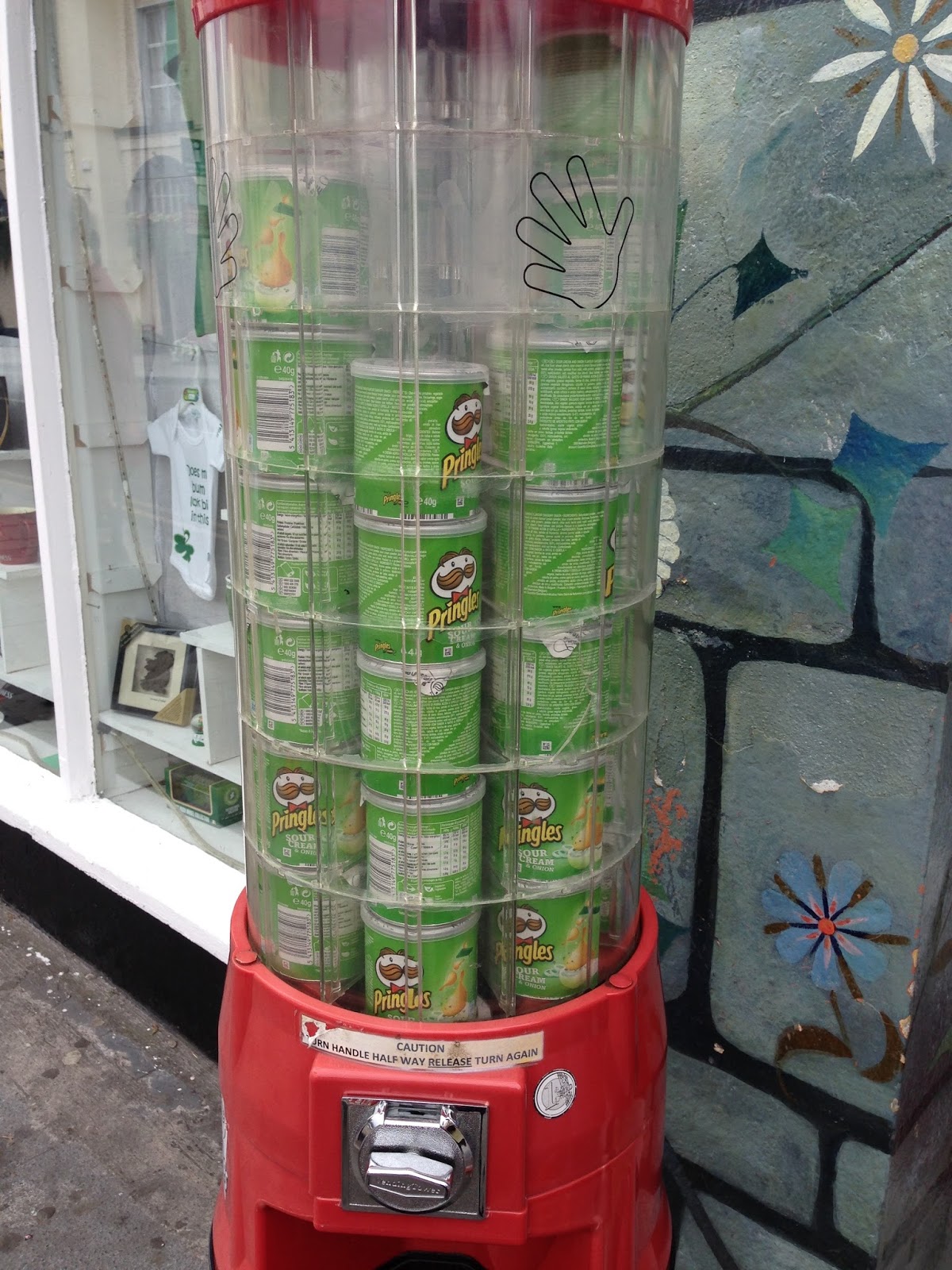
This was my favorite thing about Ireland. It might have a repressive past, but OMG Pringles vending machines!
This is a sad book. I was worried that I was stumbling into another A Little Life by Hanya Yanagihara – a book that was so devastating that I’m still crushed by it nearly two years later. But Boyne does something interesting with humor here, taking painful moments and infusing them with crackly and silly dialogue. The humor gives the reader a break from the hopelessness that can arrive when encountering the struggle for civil and human rights. It’s as if he is saying, “The pain is real, but this story is just fiction.”

I find it compelling that I made my way to these tragic books this past year, a year where we seemed to be reinforcing the darkest elements of history. One of the interesting things about making an end-of-year reading summary is looking at the themes that emerge. What do the books I read say about me? What am I looking for?

You can read an interview with Boyne here and here.

Thursday, January 11, 2018

The Top 5 of 2017: #3

If this 800 page novel had stopped after the first half, it would have been my favorite book of the year. I read it during the last week of December, basically non-stop. I had even planned to title this post, “You have never even heard of my favorite book of the year!”

You haven’t heard of The Castle Cross the Magnet Carter by Kia Corthron because it’s a first novel with a clunky, weird title and way too huge for anyone’s book club. I stumbled upon it on a independent bookstore aisle end cap with a sign underneath it that said, “Read this. Now. I mean it.” And I’m really good at following directions.

The story follows the lives of four brothers, and the reader knows they will meet at some point over the course of the novel.  Two are black and come from Maryland. Two are white and come from Alabama. All four live in segregated contexts – but it is the nuance of these contexts that makes the author’s exploration so interesting. What did friendship across race look like, feel like? What did it mean to go to separate schools but to play together in the afternoons?

Ultimately, this is a book about dignity. What happens when we don’t treat people as full human beings? And this story is not, magically, simply black and white.

Now for the bad news. Corthron wanted to write an epic novel here, and ultimately, her story loses itself somewhat in that ambition. You know how yesterday I compared Sing, Unburied, Sing to fine dining? Well, The Castle Cross... is a delicious all-you-can-eat buffet after a long hiking trip. So tasty, but by the second half, I began to bloat. There’s just too much, and the push to cover every intersectionality (e.g. the history of the gay rights movement, disability history, etc.) strains the plot. And the issue that pulled this novel to #3 from its perch at #1 is a giant, GIANT (and unnecessary) coincidence at the end.

Still, this was an amazing read. I recommend it with all of my ringing bells (though if you have problems reading about violence of any kind – warning!). This would be fantastic for a long (very long) plane ride. I was riveted.

The Castle Cross… won the 2016 Center for Fiction First Novel Prize, and as a side note, Corthron is in her 50s. Who says youngsters have all the fun?

You can read an interview with Corthron here.

Wednesday, January 10, 2018

The Top 5 of 2017: #4


I generally don’t like books that feature ghosts, and this is a novel about hauntings. But the ghosts in Sing, Unburied, Sing by Jesmyn Ward are the hauntings of injustices, and they explain the legacy of deep racism on a particular family in a particular place. On the surface this is kind of a road trip book – a family goes to pick up their father from prison in Mississippi. But while most road trip books are about the freedom of the open road, the family here isn’t yet free. The significance of the journey from small segregated town to prison is brutal.

Ward deserves all her notoriety, which includes two National Book Awards (including one for this novel) and a MacArthur Genius Award.  She approaches storytelling like a poet -- there is not a single word in her book that doesn’t matter.  Spoiler Alert: This idea will be a contrast with my Best of 2017 #s 3-1. Stay tuned!

So, basically, I knew this book would be stunning when I sat down to read it. And stunning it was, though I will admit to being more captivated with 2011’s Salvage the Bones. Reading a Ward novel is like going to a restaurant with a master chef. Every bite is meaningful and flavorful and packed with goodness. There’s no extra fat or additives, and you don’t feel bloat at the end. Her writing is, simply, brilliant.

And I’ve been struck this year how we’ve come to associate brilliance and good ideas and smart people and intellectual development with either snobbery or dullness. “Charisma” has come to mean, for the lack of a better word, shouty. I wonder what our world would look like if we read Jesmyn Ward interviews in People magazine and heard her thoughts on CNN – rather than, well, the folks that we do.

This is for sale at zazzle.com. Yay, captalism?
You can read more about Ward here and here and here.

Tuesday, January 9, 2018

The Top 5 of 2017: #5


This choice might come as a surprise to those of you who know me well. Reading With Patrick: A Teacher, a Student, and a Life-Changing Friendship by Michelle Kuo is a nonfiction account of a very young teacher who does her service with Teach For America in the rural south. I think that the Teach for America organization is problematic in so many ways, most notably for its role in the privatization of the education system and the ongoing policy attack on experienced teachers. But. BUT. I have to say that I was riveted by this account of a young woman’s struggle with her own idealism and privilege in the face of injustice. I enjoyed thinking about the larger philosophical questions that sat just underneath the surface of her writing – What is the role of education if there’s not a larger “point?” What counts as "achievement?" What if you will never see growth gains? Good scores? Is the learning itself – and the relationship that inspires it – valuable on its own terms?

Idealism has been on my mind over the course of this past year. My belief that an ordinary person can have an impact in our society has been shaken, and I find that I am drawn to stories of people who have that faith. It seems as if that is what Kuo is wrestling with here, too.  It’s not as if this book doesn’t have problems, but for me, the problems were the things that generated my questions. And I need to keep asking questions, to keep caring about people and the society we create.

Reading With Patrick was part of my foray into audio books this year. I am in the car a lot, and I have found that I add a solid handful of books to my cosmic shelves this way.

Here’s a little interview with Kuo from the New York Times.

Monday, January 8, 2018

Happy New Year!


Hello to 2018!

My apologies for the radio silence. I don’t really have a single explanation for my year-long absence. Regular blog fatigue was part of it, but a huge issue was the state of the world and its general trumpery. Everything just seemed so terrible, and with that, it was difficult to dig into my usual leaning stack of material. You already know that I gravitate toward books that are sad, sad, sad. But for most of 2017, I was full-up on sad. And every time I tried to lighten things up, by, say, picking up a book about quirky family members getting in each other’s business, the plot would turn quickly to tragedy. I read one recently about a dysfunctional family that gathered in an old estate over the holidays. Should have been safe, right? NO. A major plot point involved Ebola (Please pass the turkey, but wash your hands! Sissy has a bad virus!). 

A gift for the person who has everything: an Ebola neck tie

Meanwhile, we decided to make some changes to our house in 2017, which required moving the family and 14 years of belongings out for seven months. During that time, the internet and its decorative rabbit holes took all of my attention. It appears that between January and March of last year I read exactly one book, but I spent unquantifiable amounts of time selecting door hinges (antique nickel vs. satin nickel???! These are different, and complicatedly so.). And did you know that if you want to paint your walls blue, you have to look at grey? My new novel: Endless Shades of Grey. The plot? A couple that has been married for more than 20 years squabbles over color nuance. 


The good news is that I have rallied, and I am working on feeling hopeful about the world again. I also ended up reading quite a few books, even if I didn't blog about them. So I thought I’d start the year with a recap of my 2017 Top 5 books. Each day this week I will be posting about a book on the list. I’m looking forward to reconnecting with all of you. Here’s to better times ahead!

Wednesday, December 30, 2015

The Top 5 of 2015


It’s time to celebrate the beginning of a new reading year. That celebration requires a toast to all the pages turned over the past 12 months.


2015 was a year of books that were BREATHTAKINGLY SAD and BACK-BREAKINGLY LONG. My reading aspirations for 2016 include finding books that have fewer than 500 pages and that don’t crush my soul.

I also tried to read more diversely, incorporating a wider variety of voices and experiences through The Leaning Stack of Books Diversity Bingo Challenge. My update on that challenge is forthcoming.

It's hard for me to rank books, because I look for different things at different moments. But here are the five books that made the biggest impression on me this past year:

#5 A Little Life by Hanya Yanagihara

I know. This doesn’t make sense. This book wrecked me, and I spent the rest of the year getting over it. It was devastating to read, and I am still haunted. However, its lasting impact on me earns it a place on this list.

#4 A Man Called Ove by Fredrik Backman


This book restored my faith in humanity after finishing A Little Life. It was funny and charming and had fewer than 500 pages. Win!

#3 Citizen: An American Lyric by Claudia Rankine

This multi-form (poetry, prose, photography) exploration of race and citizenship was gripping.

#2 All the Light We Cannot See by Anthony Doerr


This book hardly needs more discussion after the year it has had. It is a beautiful fairy tale and a horror novel, all in one. I was riveted.


I was captivated by this debut novel about immigration, dislocation, and belonging. It was an easy-to-read family saga AND a book filled with weighty ideas. I couldn't put it down.


Of course, there were so many other books worth mentioning. I enjoyed (but was deeply depressed by) Dale Russakoff’s education reporting in The Prize. Erin Malone’s new collection of poetry, Hover, made me think about motherhood in new ways. Station Eleven by Emily St. John Mandel surprised me and pushed me to consider what kinds of things might endure if the world as we know it ceased to exist. And The Turner House by Angela Flournoy was a terrific debut about family, community, and urban change.

Happy New Year to all of you! Thank you so much for being a part of my reading life.