Showing posts with label YA. Show all posts

Monday, January 29, 2018

Blogtastic! The Hate U Give by Angie Thomas


Today I’m focusing on bingo square #1 on the 2017 Leaning Stack of Books Diversity Challenge: YA Novel By a Writer of Color. It’s possible that The Hate U Give by Angie Thomas is the only YA novel I read last year. I do find that I read fewer of them these days, despite having young adults in my house, because I’m not much into dystopia or dragons. Next year I might put a new square on the bingo card: YA Novel About Humans in a Real Life Situation. But, of course, the line between fictional dystopia and real life is getting more and more blurry…


I was drawn to The Hate U Give because of the buzz around it, but also because it ties into one of the content strands in the courses I teach. The last few years, my students and I have looked at Michael Brown’s death in Ferguson. I teach about education policy, and the purpose of focusing on this event has been to look at the idea of “separation” as a tool. What does segregation do in our society? Why do we intentionally separate people, and to what end? Together, we read parts of James D. Anderson’s Education of Blacks in the South, 1860-1935 to look at the logic Southerners used when they excluded African Americans from the public school system (and how African Americans fought back).  We listen to the This American Life podcast, "The Problem We All Live With, Part 1," to see the modern day version of that problem in the schools surrounding Ferguson, MO. And we read parts of We Gon’ Be Alright: Notes on Race and Resegregation by Jeff Chang to see how streets and towns and bylaws and policies were created in the Ferguson area (and most places) to invent and reinvent separation again and again.

But if I’m honest, it was not until I read Ta-Nehisi Coates’ Between the World and Me that I truly felt what it meant that the law is not on everyone’s side. The distinction between feeling and understanding is important for me. The reason that this book affected me so much is because Coates is writing a letter to his child. He is preparing him for the world, just as I have to prepare my own kids for the world. But in this letter, he is telling his son that he is not safe, that he has to carry the burden of society’s distrust and disdain.  And I felt my privilege in not having to write my own sons such a letter, and I felt through his words the pain of that process. That is what a good book can do, right? In some cases, you see your own truth validated, and in others, you get to walk in someone else’s shoes, or, perhaps, live in their skin.


The Hate U Give, which was nominated for a National Book Award for Young People’s Literature last year, is a debut YA novel that looks at the murder of an unarmed black boy by police. The story focuses on an African American teen that lives in a black neighborhood but goes to a mostly white, suburban school. When she witnesses the death of her friend, she has to navigate her experience of injustice in both contexts.

I always have to dial down my inner critic’s voice when I read YA, because I tend to feel like there’s just too much going on. Too many plot lines! Too many characters! But I suppose that’s what adolescence is -- so much simultaneous intensity. What did really interest me was the move in some communities to block access to this book, as if adults should shield kids from the world they already live in. Or is there a presumption that “YA readers” are white and should be kept separate from racial violence*?

Here’s a great article about Thomas from the Guardian.

*The reason the book was removed from school shelves in Katy, Texas was, supposedly, “explicit language.”

Tuesday, February 2, 2016

Review of Weightless by Sarah Bannan


We read Weightless by Sarah Bannan for my book club this month. Though it has literary authors’ blurbs on the cover (Colum McCann!), this struck me as YA. I do wonder, however, if teen readers would find this too much like an after school special (Message: Bullying is BAD!) to really enjoy it.


Here’s the premise: a gorgeous, mysterious new girl shows up at a high school in an insular town. At first, she is admired, but soon her peers begin to turn on her in terrible ways. The torment is relentless, and it escalates. The girl also has a troubled back story, so it is up to the reader to figure out whether bullying is causing or contributing to the character’s struggle.

Speaking of the reader, this book’s narrator is a “we.” The reader learns that the “we” is comprised is a specific group of girls who are bystanders and witnesses to the bullying. The plural narrator allows the reader to be a part of a group that does not step in to help, the kind of group that participates by being and staying silent. However, this strategy pulled me away from the story. I like to slip into the lives of characters, and the “we” gave me too much distance. I stayed separate from what should have been a very emotional experience.

One of our book club members pointed us to Sticks and Stones by Emily Bazelon, which is a nonfiction exploration of bullying. I didn’t read this whole thing, but I did read the part that featured the real case that inspired Weightless (but don't click the link to the real case if you don't want spoilers for Weightless). Bazelon’s narration of that story focused on the idea of culpability – can bullying be considered the cause of a victim’s behavior (say, if s/he commits an act of violence)? Part of the mystery of bullying is that it’s hard to pin down – what’s the difference between teasing and bullying (bullying is sustained intimidation – but who decides what intimidation is)? And there’s a growing literature about girl bullying (I liked this one), which tends to be less physical than most cases of boy bullying, but also less definable. If you snub someone repeatedly, is that bullying? Is exclusion bullying?

The biggest problem I had with Weightless is that the story was so deeply and obviously a case of teens being cruel and adults turning away from what was happening. Everything was so awful and so blatant and so terrible that there wasn’t really anything to wrestle with or consider. Was everyone responsible for what happened? Yes. Case closed. I would have been more likely to connect with a book that presented a less flashy case with more dimension.

One book club member raised the issue of the existence of grown-up bullies, and that got me thinking about whether and how Mean Adults are portrayed in literature. Do you have any good examples of books about Mean Women or Mean Men?

( This one doesn’t count).

Tuesday, March 31, 2015

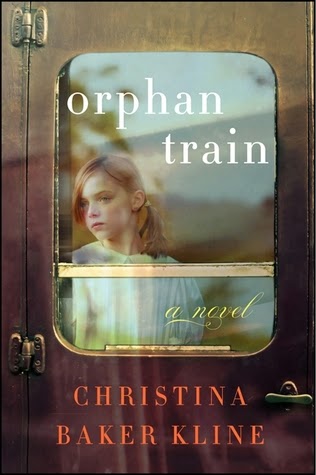
Review of Orphan Train by Christina Baker Kline


Orphan Train by Christina Baker Kline made its rounds on book club lists and “Best Of” lists in 2014. I am clearly late to the party. The story follows Molly, a Native American foster teen who needs to do community service for stealing a library book. Her service involves helping 91-year-old Vivian clean out her attic. And in cleaning the attic, Molly learns about Vivian’s experience as part of the Orphan Train program in the 1920s. Together, the two women consider the burdens they carry and how stories connect them to the past and to each other.

As I began this review, I thought that I would be revisiting the issue of the portrayal of older characters in novels. But this is not really a book about an older character and a younger one; instead, it’s a book about two girls growing up in different eras. Not only that, there is a gloss of romance, a whole bag full of coincidences that pull characters together, somewhat one dimensional adult authority figures that make the reader root for the kids, etc. This book had all the hallmarks of a Young Adult novel, but it is not being marketed that way.

Had I known that this was a good book for younger readers**, I would have approached it as such and raved about it.  It was so accessible, and I devoured it in one sitting! But I do feel a bit misled, as I was expecting something more raw and complicated. I do not mean to step into the steaming heap of last summer’s literary ruckus about whether or not YA literature is valuable for adult readers. I am trying to be a reader who tackles a broad array of books, and YA will be part of that array.  But I do read kids’ books with a different eye and a different spirit. I always ask myself if the 14-year-old version of me would have enjoyed the book. Would it have resonated with my experience or taught me something new?

All that said, this book does what good historical fiction can do: it pushes the reader to think about enduring themes in a different time and place. The Orphan Train program, which transported homeless children without parents away from east coast cities and relocated them with families in the Midwest, was the predecessor of the modern foster care system. The book’s appendices direct you to a collection of resources to find out more about the stories and experiences of Orphan Train participants (victims?). I can easily see this novel being integrated into a U.S. History class as a springboard to a larger conversation about immigration or urbanization.

You can find out about the Orphan Train program here. And you can learn more about this author here and here.

**Note for parents: high school level due to a scene of sexual violence

Sunday, February 1, 2015

Review of Brown Girl Dreaming by Jacqueline Woodson


Brown Girl Dreaming is a memoir in verse, aimed at a middle grade or young adult audience. In it, Jacqueline Woodson tells the story of her own life, wrapped in the story of her family and the story of the struggle for civil rights in America.

I really liked this book, which is both a universal portrait of growing up (sibling rivalry, friendship drama) and a portrait of an African American girl growing up at a particular time with a particular set of hopes and aspirations. The memoir covers Woodson’s family life preceding her birth in the mid-1960s up until she is around eleven years old. There are themes about place and belonging (being from the north vs. being from the south); there are themes about protest and resistance; there are themes about finding one’s own skills and aptitudes; and there are themes about community and continuity.

I read a recent New York Times review in which the reviewer wonders why Woodson gives the book the title Brown Girl Dreaming instead of just Girl Dreaming. I found that the magic of this story involved Woodson discovering her own strength and identity as an African American girl. And the idea of finding herself as a person of color with a story worth telling is certainly the anchor of the memoir. In a small vignette about a trip to the library, she writes:

If someone had taken
that book out of my hand
said, You’re too old for this
maybe
I’d never have believed
that someone who looked like me
could be in the pages of the book
that someone like me
had a story

Woodson won the National Book Award for Young People’s Literature for this book, and there was quite a scandal (by bookish standards, anyway) when emcee Daniel Handler made a racist joke while announcing her award. The incident raised questions about the ongoing struggle surrounding diversity in publishing, and, perhaps, the ongoing difficulty we have talking about race meaningfully. Woodson wrote this elegant editorial in the New York Times following the award ceremony.

I was intrigued by the author’s decision to write the book in verse. I have only read two books in verse before: The One and Only Ivan by Katherine Applegate, which won the Newbery Medal in 2013, and Jane: A Murder by Maggie Nelson, which combines poetry, prose, and primary source material. I enjoyed them both. But when I saw that Brown Girl Dreaming was written in verse, I wondered at first if kids would gravitate to the form, or if this would be one of those books that teachers love but kids ignore. Then, when Woodson mentioned finding a volume of Langston Hughes as a child, I realized that writing poetry about her life as an African American was intended to be part of a larger tradition. And while I thought Woodson's storytelling was masterful, I would love for my poet friends to weigh in and discuss whether Woodson’s poetry is good poetry.

Thursday, December 11, 2014

Review of This One Summer by Jillian Tamaki and Mariko Tamaki


Since I wrote a retro review earlier in the week about a YA title that looked at the space between childhood and adolescence, I’ll follow up with a discussion about This One Summer, which is a graphic novel that explores a similar theme. I am a graphic novel novice – I didn’t read many comic books as a kid, and I’m not particularly drawn to the format as an adult. But I know that graphic novels appeal to many readers, so I decided to try this one out.

The story, which is written and illustrated by a pair of cousins, involves two tween girls who spend the summer with their families near a Canadian lake. They are simultaneously little girls who frolic and emerging teens encountering the danger and thrill of the adult world for the first time. One girl’s growing awareness of womanhood and motherhood is particularly poignant.

Though this is marketed as a book for young people, I think adults are the best audience. There is something searing about the moment when you feel your childhood slipping away, and perhaps it’s a moment that is only recognized in retrospect. Would a kid in the midst of that moment understand it?

Interestingly, that moment is captured here in pictures, not in words. As someone who reads very, very quickly, it took work to slow down and experience this kind of storytelling visually.

For example, one of the girls is slowly learning about her mother’s grief and the way it affects her parents’ marriage. Jillian Tamaki, the illustrator, captures this growing awareness in the girl’s eyes:


In a May 2014 New Yorker article, Tamaki says that her task as the visual artist is “to make things specific and visceral.” And with that, I’m struck by the collaborative nature of graphic novels with different writers and illustrators. It would be interesting to learn more about the negotiation that must take place to bring a single story to life.

You can read an interview with the writer and the illustrator here.

And here’s an article about the growth in the graphic novel genre.

Tuesday, December 9, 2014

Retro Review of Daphne’s Book by Mary Downing Hahn

My inlaws have been in town for the past week, and I haven't finished a single book. All those goals I had last week? Unfulfilled. Next week I will be back to my regularly scheduled reading programming. Until then, here's the start of a new feature: a review of a "retro" title. 

In this case, Daphne's Book is a retro young adult title -- the kind of young adult book I would have picked up at the Walden Books in the mall in the 1980s. It was "young adult" for young teens, and we'd probably call it "middle grade fiction" today. If you're a "vintage" book enthusiast, there's a great site featuring vintage YA called "Lost Classics of Teen Lit, 1939-1989.

Daphne’s Book book was written in 1983. Look at the cover! There’s no way that a kid today would pick up a book like this one – there’s no sexy teen on the front, no faceless girl, no apocalyptic rising sun. And inside the covers, there are no wizards, no dragons, no factions or violence or sex.

As a side note, check out how the cover has changed over the years. The original is at the top of this post. Here's the one from 1995: 


And here's the one from 2008:


You can read through this article to imagine what today's version would look like.

Daphne's Book is the story of a seventh grader who is forced to be a project partner with an outcast. There is a complicated social landscape, and she has to deal with her feelings about the consequences of befriending someone that is desperately unpopular. In many ways, this storyline is reminiscent of Judy Blume’s Blubber, which was my favorite book by that author.

The second aspect of this story concerns the family life of the outcast. She lives in a rickety old house on the outskirts of town. She has a mean grandmother, and she's hungry. The main character needs to make decisions about how much of the situation to keep secret.

There are all sorts of era-specific aspects of this book: the legacy of the Vietnam War, references to “Women’s Lib,” payphones, dittoed papers at school, and combs in the back pockets of the popular girls. There is also a dated feeling of kids playing alone in the woods, wandering around town by themselves, a general freedom and lack of supervision that might not resonate with modern kids.

However, the author did capture a timeless part of being twelve years old – that sense of being in-between childhood and adolescence. The main character loves her dollhouse but hides it. She envies but shies away from the popular girls and their interest in boys. There is something so painful and poignant about the limbo of being neither a little kid nor a teenager.

I don't know if there's an audience for this kind of fiction anymore. It would be interesting to read more about the fantastical turn in kids' literature these days. It makes me wonder if the real world is not dramatic enough for today's kids, or if, perhaps, it's TOO dramatic, requiring escape. 

You can find an interesting interview with the author here. The interview is in three parts, and you can follow the links at the end to read the whole thing.

Tuesday, November 4, 2014

Review of Starbird Murphy and the World Outside by Karen Finneyfrock

In a strange twist of fate, Starbird Murphy and the World Outside has almost the same cover as Reunion, which is the last book I read.* 

The difference is that Reunion cover has a row of houses on the bottom, and the Starbird Murphy cover does not. This totally works, because the character named Starbird doesn't live in a house. She lives in a yurt with her mother on a commune in rural Washington State.

Unlike the slew of copycat dystopian novels for teens that have flooded the marketplace, this novel focuses on a utopian community. The Free Family is an egalitarian (or is it?), environmentally friendly, self-sustaining community, with a leader named EARTH (in all caps, always) who is special because he gets messages from The Cosmos. Kids in the Family receive a Calling when they become teenagers. Sometimes these Callings have to do with leadership, and sometimes they have to do with service (read: crappy tasks).

The title character receives a Calling to work in the Free Family’s off-site café, which is one of the places where the Family generates income. So after a childhood of isolation, she becomes an urban high school student/waitress. Culture shock and transformation ensue. She has to figure out what’s important to her about The Family, and whether she really believes everything she has learned about the world through its lens.

This book is so engaging because it brings the reader into an unfamiliar world (unless, I suppose, you already have a background in utopian societies), while simultaneously addressing some universal coming-of-age themes (figuring out your own identity when you have strong cultural ties; learning to stand up for yourself even if those around you don’t agree, etc.). Like many of the books I enjoy, this is a family drama (with family secrets and betrayal). And while it is most definitely a YA title, I thought it had quite a bit of adult crossover appeal, too.

Since it is Nonfiction November, I thought I’d check around for books about utopian communities. This one looks interesting – I’m intrigued by the discussion of suburbanization and utopian thinking. Has anyone read it?


* You can read an article about redundant cover art here and here